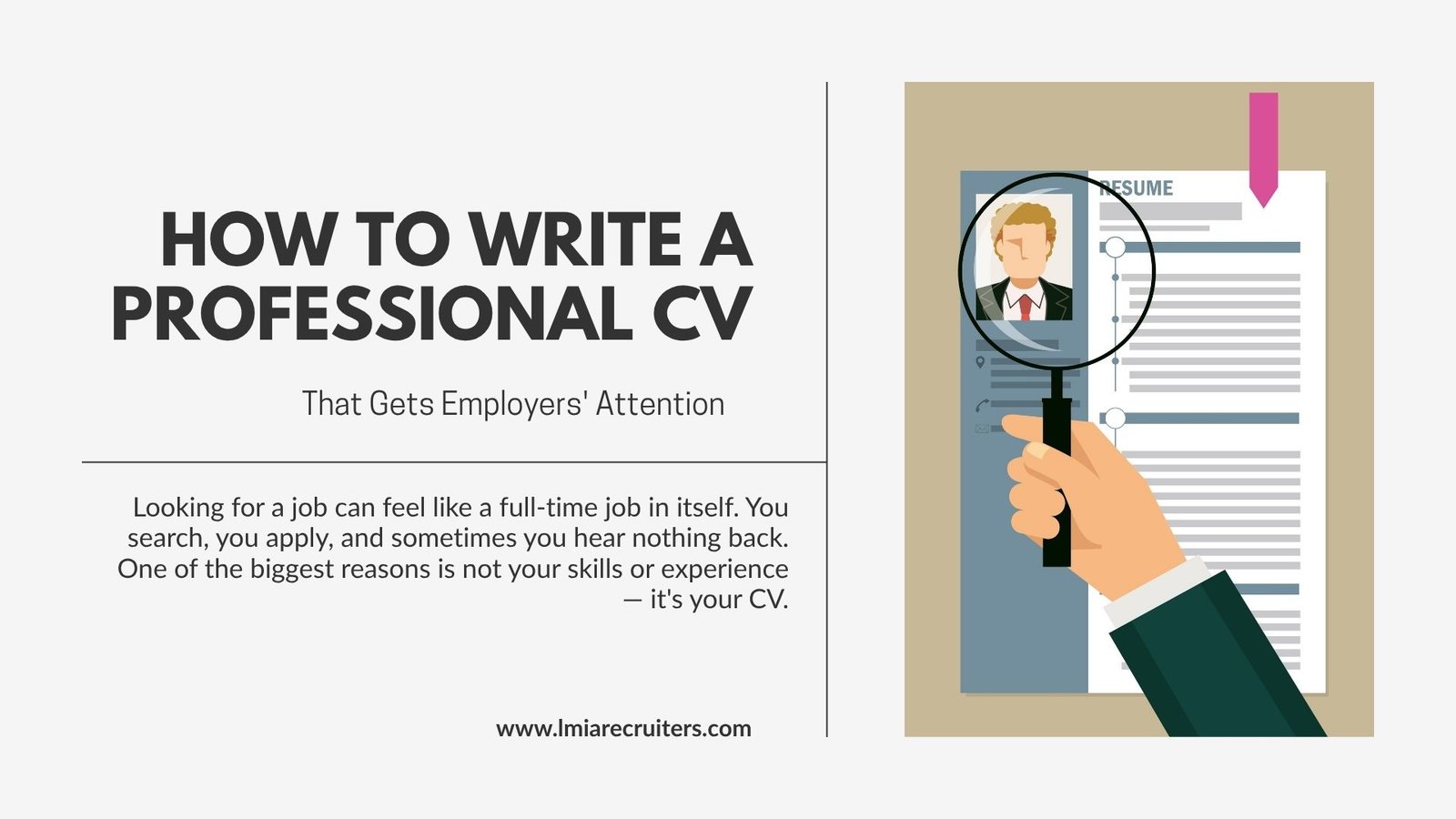
Learn how to write a professional CV that attracts employers. Discover essential CV sections, formatting tips, common mistakes to avoid, and expert advice to help you secure more interviews.
The Purpose of a CV
A good CV does three things:
- Introduces you – It tells the employer who you are professionally.
- Proves your value – It shows your skills and achievements with real evidence.
- Gets you an interview – It is not meant to get you the job directly. Its only goal is to make the employer want to meet you.
Keeping this purpose in mind will help you decide what to include and what to leave out.
Key Sections of a Professional CV
Every strong CV follows a clear structure. Let’s go through each section and what it should contain.
1. Contact Information
This goes at the top of your CV and should be easy to find. Include:
- Full name
- Phone number
- Professional email address
- City and country (you don’t need your full home address)
- LinkedIn profile or portfolio link (optional )
Example:
Joe Cooper Ontario, Canada| +1 (289) xxx-xxxx | joe.cooper@gmail.com | linkedin.com/in/Joe Cooper
2. Professional Summary or Personal Statement
This is a short paragraph (3–4 sentences) at the top of your CV. It should summarize who you are, your experience, and what you can offer.
Example:
“Marketing professional with 4 years of experience in digital campaigns and social media strategy. Skilled in growing brand awareness and increasing customer engagement by up to 35%. Looking to bring data-driven marketing skills to a fast-growing company.”
Avoid generic statements like “Hardworking and motivated individual seeking opportunities.” Instead, be specific about your skills and results.
3. Work Experience
This is usually the most important section. List your jobs in reverse order, starting with your most recent role.
For each job, include:
- Job title
- Company name
- Dates of employment
- 3–5 bullet points describing your responsibilities and achievements
Example:
Sales Executive – ABC Retail Ltd, Canada Jan 2022 – Present
- Increased monthly sales by 20% through improved customer follow-up
- Managed a portfolio of 50+ corporate clients
- Trained 5 new sales staff on company products and CRM tools
Use action verbs like managed, led, created, improved, and achieved to make your experience sound active and results-focused. Where possible, use numbers to show impact.
4. Education
List your academic qualifications, starting with the most recent. Include:
- Degree or qualification name
- Institution name
- Years attended
- Relevant honors or achievements (optional)
Example:
Bachelor of Commerce, Marketing Option University of Toronto, 2018 – 2022
If you have many years of work experience, keep this section short. If you are a recent graduate, you can add more detail, such as relevant coursework or projects.
5. Skills
List both hard skills (technical abilities) and soft skills (personal qualities) that match the job you are applying for.
Example:
- Digital Marketing (SEO, Google Ads, Social Media)
- Data Analysis (Excel, Google Analytics)
- Project Management
- Team Leadership
- Communication and Negotiation
Tip: Read the job description carefully and include skills that match what the employer is asking for. This also helps your CV pass through Applicant Tracking Systems (ATS), which many companies use to filter CVs before a human even sees them.
6. Additional Sections
Depending on your background, you may also include:
- Certifications (e.g., Google Analytics Certified, PMP)
- Languages (e.g., English – Fluent, French – Intermediate)
- Volunteer Work (especially useful if you have limited job experience)
- Awards and Achievements
These sections are optional, but they can help you stand out, especially if they are relevant to the job.
Common CV Mistakes to Avoid
Even strong candidates lose opportunities because of small CV mistakes. Avoid these common errors:
1. Using One CV for Every Job
Sending the same CV to every employer is a common mistake. Always tailor your CV to match the specific job description and highlight the most relevant skills and experience.
2. Including Too Much Information
A CV is not your full life story. Avoid listing every task from every job. Focus on achievements and responsibilities that are relevant to the position you are applying for.
3. Spelling and Grammar Errors
Typos make a bad first impression and suggest a lack of attention to detail. Always proofread your CV, or ask someone else to review it before sending it out.
4. Using an Unprofessional Email Address
An email like “partyqueen22@email.com” can hurt your credibility. Use a simple, professional email address based on your name.
5. Poor Formatting
Avoid using too many fonts, colors, or cluttered designs. Stick to a clean, simple layout with consistent formatting, clear headings, and enough white space to make the document easy to read.
6. Not Including Measurable Results
Saying you “helped increase sales” is weaker than saying you “increased sales by 20% in six months.” Numbers make your achievements more convincing.
7. Forgetting to Update Contact Information
It may sound obvious, but many people forget to update their phone number or email address after a change. Double-check this every time you send your CV.
Conclusion
Writing a professional CV is not about listing everything you have ever done. It’s about presenting the right information, in the right order, in a way that quickly shows an employer why you are worth interviewing.
Focus on a clear structure, tailor your CV for each job, highlight measurable achievements, and avoid common mistakes like poor formatting or generic language. With these tips, you’ll be well on your way to creating a CV that gets noticed and helps you land more interviews.
Take the time to review and update your CV regularly, especially as you gain new skills and experience. A strong, well-crafted CV is one of the most valuable tools in your job search — invest in it accordingly.
If you’re ready to put your CV to work, explore the latest opportunities available on our platform: